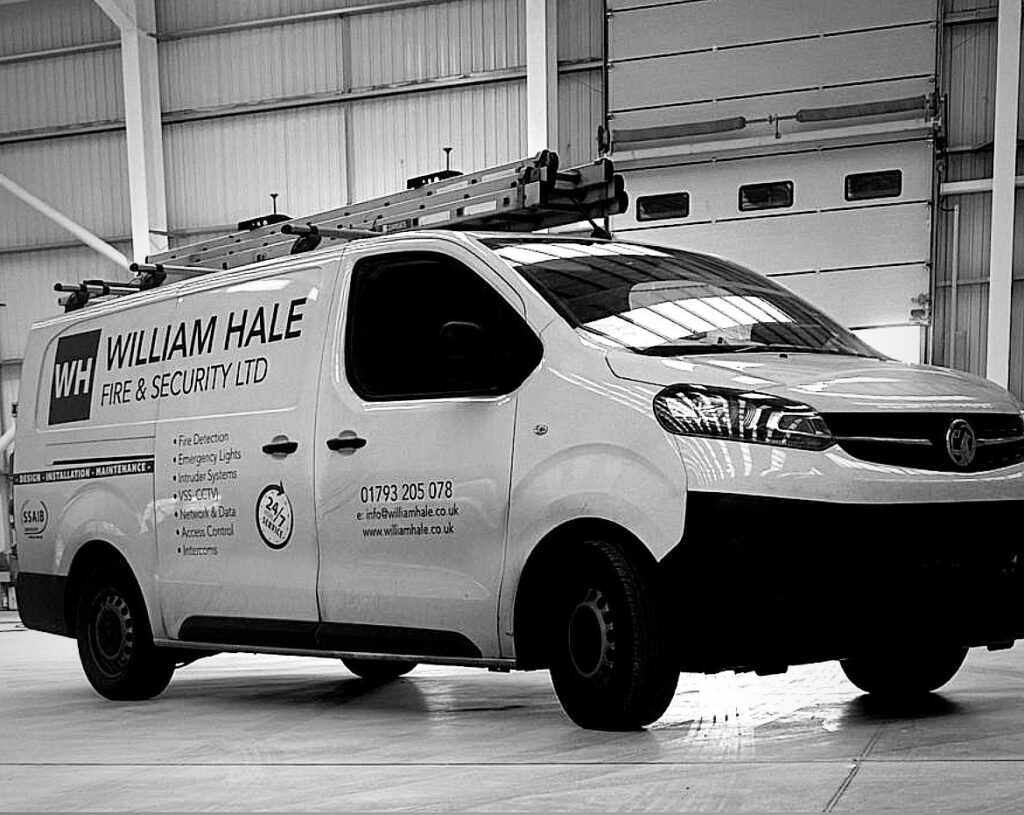
Welcome to William Hale Fire & Security Limited

Emergency Lighting Wiltshire

Get an Emergency Lighting Quote

Emergency Lighting Installation Wiltshire

Emergency lighting exists to do one job well: keep a building navigable when the mains supply fails. The moment power is lost, escape routes fall dark, stairwells become genuine hazards, and anyone unfamiliar with the layout loses all sense of direction. A correctly designed system removes that risk by switching to battery power within seconds, holding illumination for a minimum of three hours, and giving every occupant a clear, lit path to a final exit. It is a legal requirement under fire safety legislation for virtually every non-domestic building, and it is among the first things an inspecting officer will ask to see. Good work here starts with design rather than hardware. Escape routes are mapped, risk points identified — changes of level, corridor intersections, direction changes, fire alarm call points, firefighting equipment — and luminaires positioned so each of those points is properly covered. Illuminance along the centre line of an escape route, uniformity ratios and disability glare limits all have to be satisfied, which is why guesswork so rarely survives inspection. Installation work across Wiltshire ranges from single-storey units through to multi-let premises with layered escape strategies. Cabling is run discreetly, luminaires are matched to the finish of the space rather than imposed on it, and the completed system is commissioned, tested and handed over with a certificate and a properly set up logbook. Maintenance carries equal weight. Batteries degrade, lamps fail, and internal layouts shift as partitions are moved. Monthly function tests and an annual full-duration discharge test keep a system compliant and, more importantly, keep it working. Anyone searching for emergency lighting near me is normally after that whole sequence — design, install, test, certify — delivered by one team rather than three, with documentation that stands up to scrutiny when it is finally called upon.

cctv installation
fire detection system

About Us

Founded in early 2013, William Hale Fire & Security have established a reputation built on the focus of a customer centred approach, whilst offering expert practical advice and providing a reliable and trusted service for homes and businesses in Wiltshire.

Our highly skilled and experienced workforce liaise closely with both our residential and commercial clients, paying attention to detail to ensure we meet the individual needs of our customers, to provide a bespoke, cost effective and high-quality solution.

As an SSAIB certified company we are recognised for our ability to consistently meet the industry’s highest standards.

Why Choose Us

13 Years Experience

"13 years of reliable, customer-focused expertise."

24/7 Support

"Reliable, round-the-clock support for your safety."

Industry Certified

Industry-certified, trusted, reliable, customer-focused, expert advice.

Reliable Emergency Lighting Systems in Wiltshire.

Emergency lighting

Why Choose Us For Emergency Lighting?

Choosing an electrical contractor for life safety work is a different exercise from choosing one for general installation. The system has to perform on the single day it is needed, and the paperwork has to prove it was capable of doing so. That is the standard William Hale works to on every project in Wiltshire, whether it is a first-time fit, a system upgrade, or taking on the maintenance of something another contractor installed years ago. Work begins with a site survey rather than a price list. Escape routes are walked, existing luminaires assessed for age and battery condition, and a schedule produced showing exactly what is being installed, where, and why each position is needed. Quotations are itemised, so there are no vague provisional allowances that quietly inflate once work starts. Engineers are qualified to the relevant standards and comfortable working in occupied buildings. In practice that means early starts, evening slots or phased works where a business cannot absorb disruption, dust sheets down as standard, and cable routes chosen to avoid damaging existing finishes. Discharge tests are scheduled sensibly and agreed in advance rather than sprung on a manager mid-morning. Every completed job is handed over with a full commissioning certificate, an as-fitted drawing showing luminaire positions and circuit references, and a logbook set up correctly from day one. When a responsible person is asked to evidence compliance, everything sits in one place. Reactive response matters just as much as planned work. Failed fittings and battery faults are attended promptly, with common lamps, batteries and control gear carried on the van so most issues are resolved on a first visit. Ongoing emergency lighting testing can be scheduled annually so nothing slips. For anyone comparing emergency lighting engineers near me, competence, clear pricing and defensible paperwork are usually what decide it.

Our Partners

Our trusted partners ensure seamless collaboration, enhancing our commitment to exceptional customer service.

Commercial Emergency Lighting Wiltshire

Commercial premises carry a heavier compliance burden than most, and emergency lighting is where that burden tends to be most visible. Offices, retail units, warehouses, care settings, hospitality venues and light industrial buildings all fall under the same duty: the responsible person must ensure escape routes remain usable during a power failure, and must be able to demonstrate that on request. Scale changes the design entirely. A large open-plan floorplate needs anti-panic lighting so that occupants can reach a marked route in the first place, not simply lighting along the route itself. Warehousing with high racking creates deep shadow, so luminaire spacing has to account for obstruction rather than assume an empty box. Plant rooms and spaces containing moving machinery are treated as high-risk task areas, requiring far higher illuminance so a process can be shut down safely before anyone evacuates. Multi-occupancy buildings bring complications of their own. Common parts, stairwells, lift lobbies and service corridors often sit outside any single tenant’s demise, and responsibility for testing has a habit of drifting between parties. Clear zoning, labelled circuits and an accurate as-fitted drawing prevent that ambiguity taking hold. Commercial emergency lighting installation in Wiltshire is frequently phased. Trading hours, shift patterns and stock movements dictate when areas can be accessed, so works are sequenced floor by floor or zone by zone with temporary cover maintained throughout. Where a building is being refurbished, luminaire positions are coordinated against the new ceiling grid, partition layout and signage strategy so nothing has to be relocated twice. Testing regimes on commercial sites are best automated. Self-test luminaires or an addressable central system remove the manual monthly walk-round and produce a report instead, which is considerably more reliable in a building holding several hundred fittings.

Get in Touch for Emergency Lighting in Wiltshire Today

cctv installation

Different Types of Emergency Lighting

Emergency lighting is not a single product but a family of them, and specifying the wrong type is a common reason systems fail inspection. The first distinction is operational. Maintained luminaires are lit continuously, drawing from the mains in normal conditions and transferring to battery on failure — the usual choice for exit signs and for places of assembly where general lighting is dimmed. Non-maintained fittings stay dark until the supply drops and then illuminate, which suits offices, corridors and workshops where normal lighting is always on while the building is occupied. Sustained fittings combine both, using separate lamps for mains and emergency duty. The second distinction is where the battery lives. Self-contained luminaires hold their own cell, which keeps installation straightforward and limits the consequences of any single failure. Central battery systems feed multiple fittings from one location, simplifying testing and battery replacement in larger buildings, though they demand fire-rated cabling and careful circuit design. Function defines a third category. Escape route lighting illuminates the defined path to a final exit. Open area, or anti-panic, lighting covers larger floor areas so occupants can locate that path. High-risk task area lighting protects people working with machinery or hazardous processes. Standby lighting, strictly speaking, is not emergency lighting at all — it allows normal activity to continue and is specified separately. Exit signage forms its own class, with pictogram signs sized to viewing distance and positioned so at least one remains visible from any point on the route. Photoluminescent signage supplements illuminated units but never replaces them. Finally there is testing capability: manual key-switch systems, self-testing luminaires that check themselves automatically, and fully addressable systems logging results centrally. Selecting the right combination for a building in Wiltshire is a design decision, not a shopping one.

Emergency Lighting FAQs

What is emergency lighting?

Emergency lighting provides illumination when the normal power supply fails, helping people safely navigate and evacuate a building during an emergency. It can be particularly important during fires, power cuts and other situations where the main lighting is unavailable.

Emergency lighting helps occupants identify escape routes, exits and important safety signs when normal lighting has failed. A properly designed and maintained system can make evacuation safer and reduce the risks associated with poor visibility during an emergency.

Many commercial and public buildings require suitable emergency lighting as part of their fire safety arrangements. The exact requirements depend on the type, size and layout of the property, its occupancy and the available escape routes. A professional assessment can help determine the appropriate system for your premises.

Emergency lighting should be tested and maintained regularly to make sure it operates correctly when needed. Testing should be carried out in accordance with the relevant requirements for the building and system, with records retained as appropriate.

Yes. William Hale Fire & Security provides emergency lighting installation for properties across a range of locations, including commercial, industrial and residential premises. The company designs systems around the individual requirements and layout of each property.

If an emergency light fails a test, the cause should be investigated and the necessary repair or replacement carried out. Leaving faulty emergency lighting unresolved could leave occupants without adequate illumination during a power failure or emergency.

Yes. Existing systems can be upgraded where equipment is outdated, damaged or no longer suitable for the property. An upgrade can also provide an opportunity to improve reliability and incorporate newer emergency lighting technology.

Yes. Regular maintenance helps ensure emergency lighting remains operational and suitable for the property. William Hale Fire & Security offers maintenance services alongside emergency lighting installation and can provide ongoing support for existing systems.

Emergency lighting can be designed for a wide range of properties, including offices, shops, warehouses, industrial premises and residential buildings. The system should be designed according to the property’s individual layout, occupancy and safety requirements.

Professional installation helps ensure the emergency lighting system is properly designed, positioned and fitted for the building. William Hale Fire & Security provides bespoke emergency lighting solutions using modern technology and industry-leading manufacturers.

Our Client Testimonials

Our Customer Testimonials

Contact Us

Get Expert Advice and a Free Emergency Lighting Quote in Wiltshire

Emergency Lighting: Keeping Your Property Safe During a Power Failure

Emergency lighting is an important part of keeping people safe when normal lighting fails. Whether a building experiences a power cut, fire or another emergency, losing mains lighting can make it difficult for occupants to find their way around safely. A correctly designed emergency lighting system provides illumination along important routes and helps people identify exits and safety equipment when they need it most.

For businesses and property owners looking for emergency lighting in Wiltshire, choosing the right system is about more than simply installing a few emergency lights. The system needs to suit the building, its layout and the people using it. Professional emergency lighting installation can provide a reliable solution designed around the individual requirements of the property.

Why Is Emergency Lighting Important?

Imagine a power failure occurring while a building is occupied. Normal lights go out, visibility is reduced and occupants may not immediately know where to go. In an emergency, this confusion can create unnecessary risks.

Emergency lighting is designed to provide illumination when the normal power supply fails. It can help occupants find safe passage out of a building during situations such as a fire or power cut. Emergency safety signs are also an important part of the overall system, helping employees, visitors and members of the public identify evacuation routes and important safety equipment.

For this reason, emergency lighting should be considered an essential part of a property’s wider safety arrangements.

Professional Emergency Lighting Installation in Wiltshire

Every building has different requirements. An office, warehouse, retail premises and residential property can have very different layouts, occupancy levels and escape routes.

Professional emergency lighting installation in Wiltshire allows a system to be designed around the specific property rather than relying on a one-size-fits-all approach. William Hale Fire & Security designs, installs and maintains a wide range of emergency lighting systems for different property requirements.

Whether you need emergency lighting installation near me, a new emergency lighting system for a commercial property or improvements to an existing setup, the right solution should provide dependable illumination when the main lighting system is unavailable.

Emergency Lighting for Commercial Properties

Commercial buildings can have large numbers of employees, customers and visitors moving through them every day. If the main lighting fails, everyone needs to be able to identify safe routes out of the building.

Commercial emergency lighting can be suitable for a wide range of premises, from offices and shops to larger industrial buildings and warehouses. Systems can be designed around the property’s individual layout and requirements.

Businesses searching for emergency lighting near me should consider both installation and ongoing maintenance. A system needs to remain dependable over time, rather than simply working correctly on the day it is installed.

Emergency Lighting Systems Designed Around Your Property

There is no single emergency lighting system that is suitable for every building. The size and layout of the property, its use and the requirements of the occupants can all influence the appropriate solution.

William Hale Fire & Security works with industry-leading manufacturers and uses up-to-date technology when designing and installing emergency lighting systems. The company offers a range of solutions intended to meet different client requirements, expectations and budgets.

This tailored approach can be particularly useful for businesses looking for emergency lighting installation in Wiltshire, where the system needs to work effectively within an existing building.

Emergency Lighting and Safety Signs

Emergency lighting is not only about illuminating a room or corridor. Safety signs also play an important role in helping people understand where they should go during an emergency.

When normal lighting fails, clearly visible emergency signs can help occupants identify evacuation routes and exits. They can also provide information about how to locate or operate important emergency equipment safely.

Combining appropriate emergency illumination with clear safety signage helps create a more effective evacuation system.

Emergency Lighting Maintenance

Installing emergency lighting is only the beginning. Regular maintenance is important to help ensure the system remains operational and ready to perform when required.

Over time, emergency lighting equipment can develop faults or components can become less effective. Regular professional attention can help identify issues before an emergency occurs.

For property owners searching for emergency lighting maintenance near me, working with an experienced provider can provide greater confidence that the system continues to meet the needs of the building.

Upgrading Existing Emergency Lighting

Older emergency lighting systems may not provide the same level of performance, efficiency or functionality as newer solutions. An existing installation may also need to be updated as a property changes.

An emergency lighting upgrade can provide an opportunity to improve an existing system and ensure it remains suitable for the current building layout and requirements.

If you are searching for emergency lighting upgrades in Wiltshire or emergency lighting contractors near me, a professional assessment can help determine whether your existing system should be upgraded, replaced or maintained.

Choosing an Emergency Lighting Company Near Me

When searching for emergency lighting companies near me, it is important to look beyond installation alone. Consider whether the company can design a suitable system, install it professionally and provide ongoing maintenance.

William Hale Fire & Security has provided fire and security services since 2013 and focuses on practical advice, customer service and reliable solutions. Its emergency lighting service covers system design, installation and maintenance, using modern technology and products from leading manufacturers.

For customers looking for emergency lighting in Wiltshire, this complete approach can make managing the property’s emergency lighting requirements much simpler.

Emergency Lighting Near Me

If you are searching online for emergency lighting near me, emergency lighting installers near me or emergency lighting installation near me, the most important consideration is finding a system that is appropriate for your property.

William Hale Fire & Security provides emergency lighting solutions across locations including Bristol, Bath, Gloucester, Gloucestershire, Swindon, Cheltenham, Oxford, Oxfordshire, Cirencester, Hereford, Worcester, Wiltshire and the Cotswolds, as well as West London and surrounding areas.

Whether you need a new emergency lighting system, an installation, an upgrade or ongoing maintenance, professional advice can help ensure your property has a dependable solution in place.

Protect Your Property with Professional Emergency Lighting

Emergency lighting can make a significant difference when normal lighting fails. By illuminating important areas, helping occupants identify safe routes and supporting the use of emergency safety signs, a properly designed system can help people leave a building safely during an emergency.

If you need emergency lighting in Wiltshire, professional emergency lighting installation, emergency lighting maintenance or an emergency lighting upgrade, William Hale Fire & Security can design and maintain a solution around your property’s individual requirements.

Call Now Button